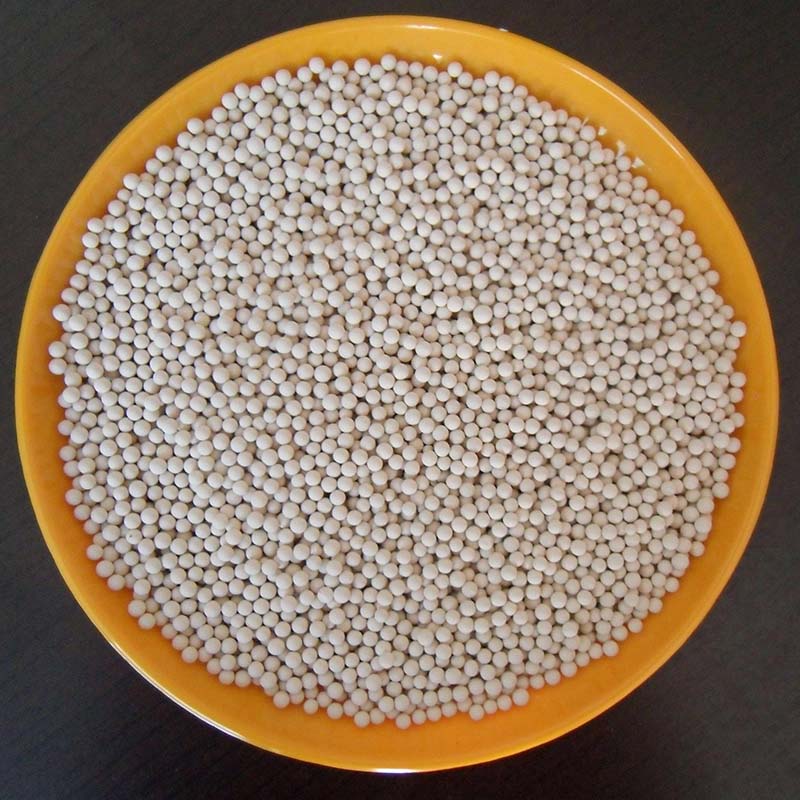
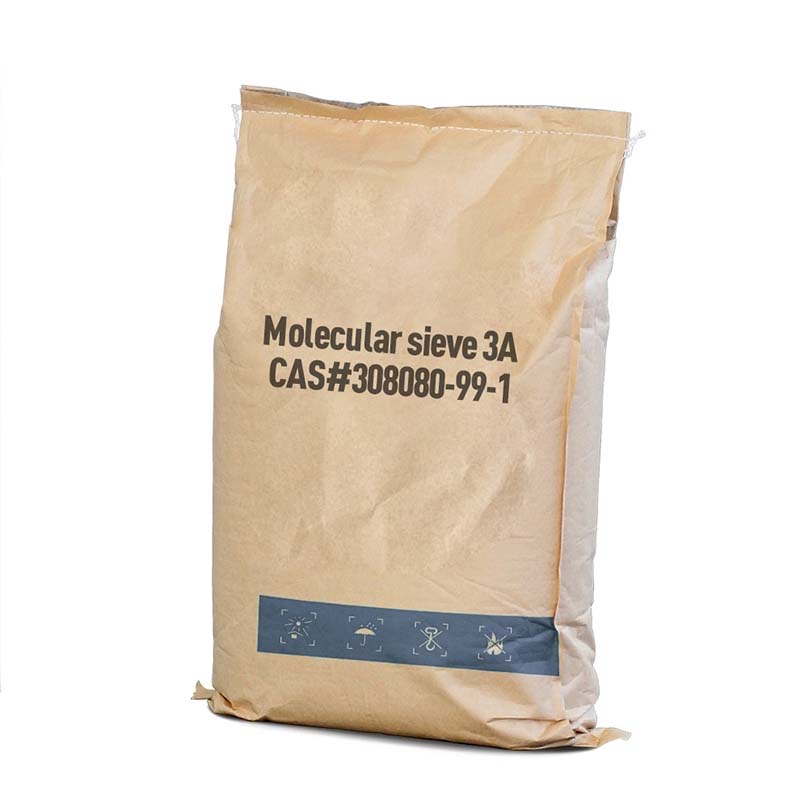
Molecular Sieve 3A CAS No.: 308080-99-1 (typical)
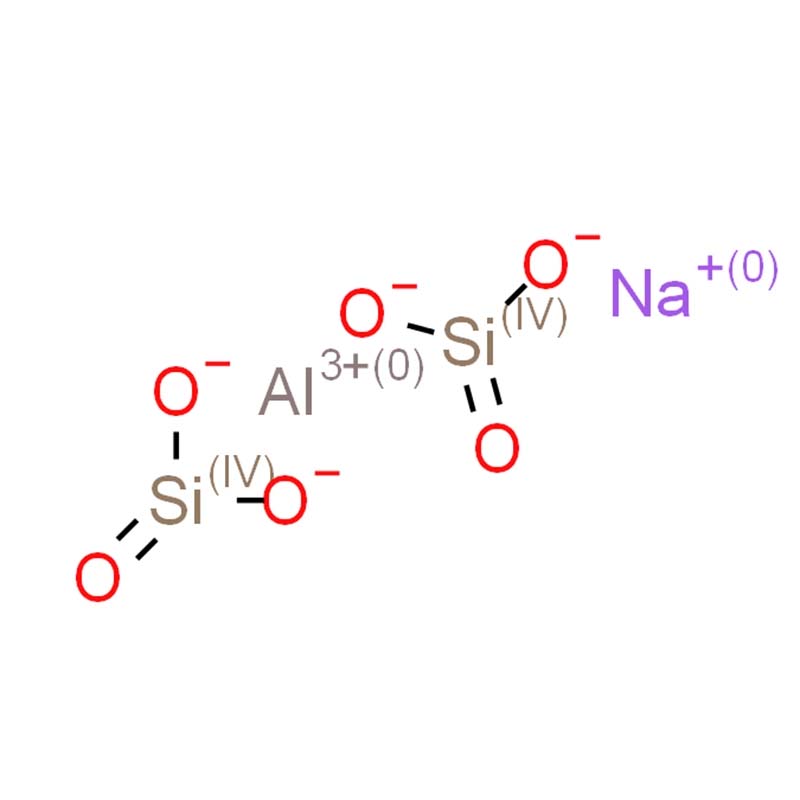
Molecular Sieve 3A is an alkali metal aluminosilicate with a precisely controlled pore size of approximately 3 angstroms (0.3 nm) . It is the potassium-exchanged form of the 4A structure, which effectively restricts its adsorption to only small molecules like water (kinetic diameter ~2.65 Å) while completely excluding larger hydrocarbons such as ethane or ethylene . This size-selectivity makes it the industry-standard desiccant for drying highly reactive unsaturated streams (e.g., cracked gas, propylene, butadiene) and polar liquids like ethanol and methanol, where it can achieve exceptionally low water dew points without co-adsorbing valuable olefins
1. Overview
Molecular Sieve 3A is a synthetic zeolite (crystalline aluminosilicate) with a pore opening of approximately 3 Angstroms (0.3 nm) . It is the potassium-exchanged form of Type A zeolite (4A). This pore size selectively adsorbs molecules with an effective kinetic diameter of less than 3Å while excluding larger molecules. 3A is specifically designed for drying unsaturated hydrocarbons and polar liquids where co-adsorption of the process fluid must be minimized.
2. Key Features
Precise 3Å Pore Size – Adsorbs water (kinetic diameter ~2.65Å) but excludes larger molecules like ethylene, propylene, and methanol .
High Water Adsorption Capacity – Typically 19-21% wt/wt at 25°C, 60% RH .
Excellent Selectivity – Minimizes hydrocarbon co-adsorption, reducing product loss .
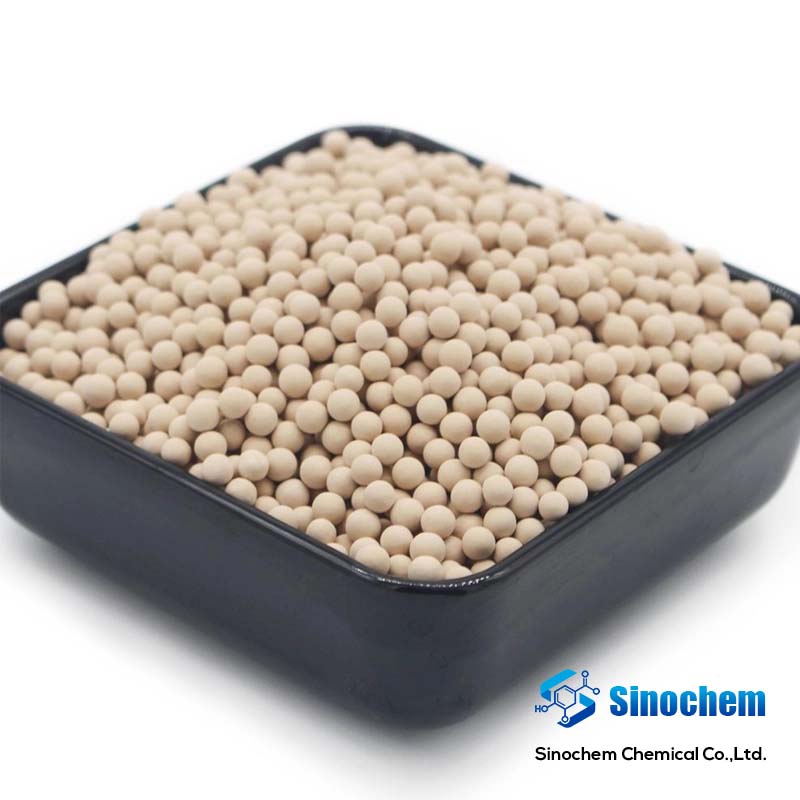
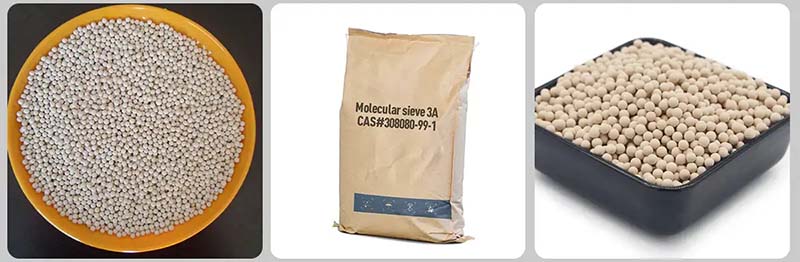
High Mechanical Strength – Available in beads (sphere) or pellets (extrudate) with low dusting .
Thermal & Chemical Stability – Withstands regeneration temperatures up to 250-300°C .
3. Key Specifications with Explanation
| Parameter | Typical Value | Explanation |
|---|---|---|
| Pore Size | 3 Å (0.3 nm) | Excludes molecules larger than ~3Å (e.g., C₂H₄, C₃H₆, CH₃OH, C₂H₅OH) . |
| Water Adsorption Capacity | ≥19-21% wt/wt (25°C, 60% RH) | Measures drying capacity; higher is better for deep drying . |
| Bulk Density | 0.65 – 0.75 g/mL (beads) | Affects vessel loading weight and pressure drop calculations . |
| Crush Strength | ≥20 – 80 N/bead (varies by size) | Indicates mechanical durability; prevents dust generation . |
| Loss on Ignition (LOI) | ≤1.5 – 2.0% (550°C) | Water content after activation; lower indicates higher activation level . |
| Static Adsorption (RH=60%) | ≥19% | Standard industry test for adsorption capacity . |
| Dynamic Adsorption (C₂H₄, 25°C) | ≤0.3% | Measures hydrocarbon co-adsorption (must be low) . |
| Particle Size | 1.6-2.5mm, 2.5-5mm, 8x12 mesh, etc. | Smaller beads = faster kinetics; larger beads = lower pressure drop . |
| Attrition Loss | ≤0.1-0.5% | Measures dusting tendency; low attrition critical for long bed life . |
| Regeneration Temperature | 200-300°C | Temperature required to drive off adsorbed water . |
4. Applications
| Application Area | Specific Uses |
|---|---|
| Olefin Drying (Primary Use) | Drying of ethylene, propylene, butadiene, and other unsaturated hydrocarbons. 3A prevents co-adsorption and polymerization of olefins . |
| Refrigerant Drying | Drying of refrigerants (R-134a, R-410A, R-32) in AC and refrigeration systems . |
| Natural Gas & LPG Drying | Deep drying of natural gas, LPG (propane, butane) to prevent hydrate formation . |
| Ethanol Dehydration | Producing anhydrous ethanol (gasoline blending) – breaks azeotrope with water . |
| Solvent Drying | Drying of polar solvents (acetone, methanol, THF, acetonitrile) where 4A would co-adsorb the solvent . |
| Insulated Glass (IG) Units | Desiccant in sealed insulating glass windows to prevent fogging . |
| Air & Gas Drying | Drying of compressed air, CO₂, and inert gases where minimal hydrocarbon adsorption is required . |
Why 3A instead of 4A or 13X?
| Application | Why 3A is Preferred |
|---|---|
| Ethylene/Propylene drying | 4A adsorbs olefins; 3A excludes them → less product loss |
| Ethanol dehydration | 3A adsorbs water but excludes ethanol (kinetic diameter ~4.3Å) |
| Refrigerant drying | 3A does not adsorb refrigerant molecules → no performance loss |
| Insulated glass | 3A prevents fogging without adsorbing insulating gases (Ar, Kr) |
5. Grade/Type Comparison
| Type | Form | Particle Size | Crush Strength | Typical Use |
|---|---|---|---|---|
| 3A Beads (Sphere) | Sphere | 1.6-2.5mm, 2.5-5mm, 4-6 mesh | ≥20-80 N | Packed beds, high flow rates, low pressure drop |
| 3A Pellets (Extrudate) | Cylinder | 1.6mm, 3.2mm dia | ≥20-40 N | Smaller vessels, radial flow beds |
| 3A Powder | Fine powder | <45 µm (325 mesh) | N/A | Polymer additives, coatings, composite desiccants |
| 3A with Binder | Beads/Pellets | Standard | Higher | High mechanical stress applications (e.g., moving beds) |
| 3A Binderless | Beads/Pellets | Standard | Lower | Maximum adsorption capacity, minimal inert material |
Mesh Size Equivalents:
| Mesh Size (US) | Diameter (mm) | Typical Application |
|---|---|---|
| 8×12 | 1.7 – 2.4 mm | General purpose, fast kinetics |
| 4×8 | 2.4 – 4.8 mm | Large vessels, lower pressure drop |
| 6×10 | 2.0 – 3.4 mm | Standard olefin drying |
| 10×20 | 0.85 – 2.0 mm | Smaller beds, rapid cycling PSA |
6. Buying Guide
Select by Application:
Ethylene/propylene drying → 3A beads, 1.6-2.5mm or 8×12 mesh, high crush strength .
Ethanol dehydration → 3A beads or pellets, high adsorption capacity (>20%) .
Refrigerant drying → 3A beads, low dust, certified for refrigerant compatibility .
Insulated glass → 3A beads, low dust, specific IG unit packaging (polymer bags) .
Solvent drying (lab scale) → 3A beads or pellets, 8×12 mesh, low fines .
Key Quality Parameters to Verify:
Water adsorption capacity – Should be ≥19% (min 18% for industrial spec) .
Crush strength – Higher is better for long bed life (min 20 N for 1.6mm beads) .
Attrition loss – Should be ≤0.2% for critical applications .
Hydrocarbon co-adsorption – For olefin drying, request ethylene or propylene adsorption data (<0.3%) .
Activation & Regeneration:
Activation (before use) : Heat at 200-300°C for 2-4 hours in a flowing inert gas or vacuum .
In-situ regeneration : Heat at 200-250°C with hot dry gas flow (N₂ or dry air) .
Do not exceed 300°C – prolonged overheating can damage crystal structure .
Cool to <50°C before exposing to process fluid to prevent thermal shock .
Storage:
Store in airtight containers – highly hygroscopic, will adsorb moisture from air .
Shelf life (unopened) : 12-24 months in sealed packaging .
Once opened, use immediately or reseal tightly. Regenerate before use if exposed to air for >1 hour .
Supplier Verification:
Request CoA confirming pore size, water capacity, crush strength, and particle size distribution .
For olefin applications, request hydrocarbon co-adsorption test results .
Verify binder type (clay binder standard; inorganic binder for high-temp applications) .
7. FAQ
Q: What is the difference between 3A, 4A, and 5A molecular sieves?
A: 3A (pore size 3Å) – potassium exchanged, excludes molecules >3Å (ethylene, propylene, ethanol).
4A (pore size 4Å) – sodium form, adsorbs C₂H₄, C₃H₆, ethanol, etc.
5A (pore size 5Å) – calcium exchanged, adsorbs normal paraffins (C₄–C₆) .
Use 3A when drying unsaturated hydrocarbons or ethanol; use 4A for general drying (air, refrigerants); use 5A for normal paraffin separation.
Q: Can 3A be regenerated?
A: Yes. Heat to 200-300°C for 2-4 hours under dry gas flow or vacuum. Multiple regenerations are possible (hundreds of cycles) if bed is not contaminated. Performance gradually declines over many cycles.
Q: Is 3A safe for food/medical applications?
A: Yes, if properly activated and contained. 3A is non-toxic and used in pharmaceutical drying (API manufacturing) and food-grade ethanol production. Ensure supplier provides food/pharma grade certification if required.
8. Delivery, Certification & Service
Packaging:
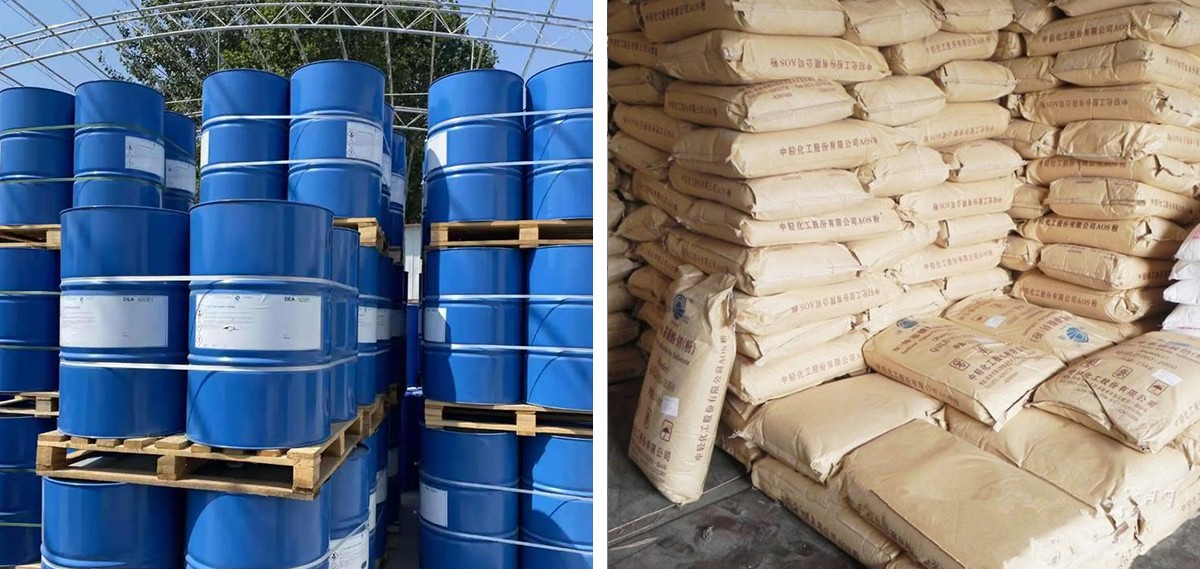
Small containers : 1kg, 5kg, 25kg sealed aluminum foil bags or HDPE drums.
Industrial bags : 150kg net steel drum, 140-150kg paper bag (with PE liner).
Bulk : 500kg-1000kg super sacks or pneumatic truck delivery.
IG units : Pre-dosed polymer bags (e.g., 1.5kg/bag for double-glazed windows) .
Lead Time: Stock items: 2-5 business days; custom sizes: 2-4 weeks.
Documentation: CoA (capacity, crush strength, attrition, LOI), MSDS, TDS, and (for specific markets) REACH, RoHS, or food contact certificates.
Certifications: ISO 9001 (manufacturing), some suppliers provide ISO 14001 and ISO 45001 .
Shipping: Not classified as dangerous goods. Keep dry during transport (waterproof liners required). Avoid extreme humidity.