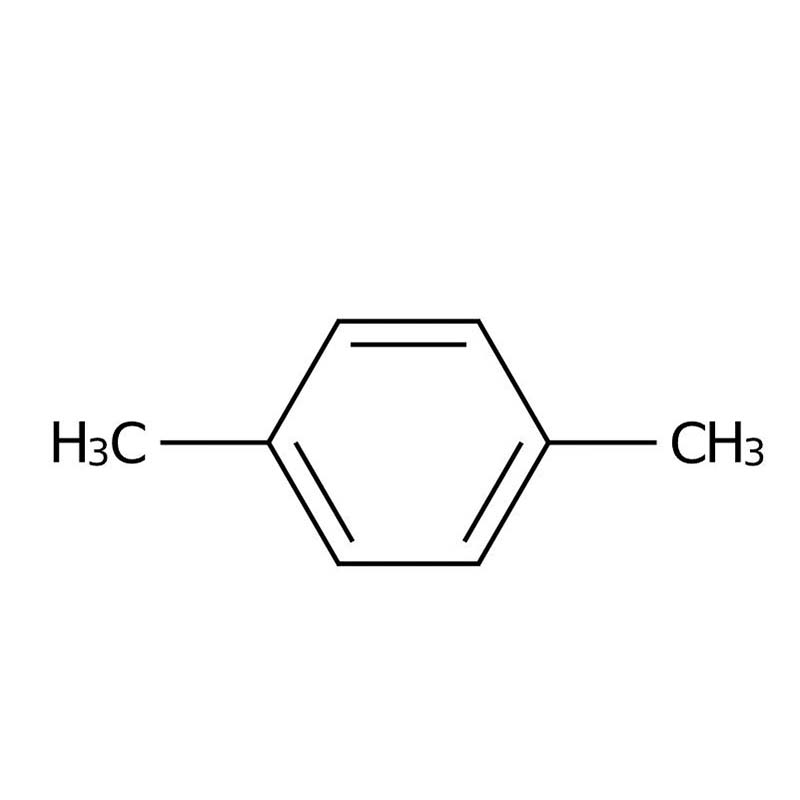
p-Xylene CAS:106-42-3
Key Chemical Building Block:This compound acts as the main raw material for producing terephthalic acid (PTA), dimethyl terephthalate (DMT) and polyethylene terephthalate (PET), forming the core basis for making polyester polymers.
Broad Solvent Application:As an efficient solvent, it is widely used in pharmaceutical synthesis, fragrance preparation and printing ink production.
Large‑Scale Industrial Production:It is manufactured through catalytic disproportionation of toluene and isomerization of xylene, allowing cost‑effective mass production.
Physical and Chemical Stability:This material remains stable under normal processing conditions and is only slightly soluble in water, ensuring reliable performance in various industrial uses.
Paraxylene is an essential basic organic intermediate, which is mainly used as the core raw material for synthesizing terephthalic acid (PTA), dimethyl terephthalate (DMT) and polyethylene terephthalate (PET), the key basic material for polyester production. Besides, it also acts as an industrial solvent and feedstock for preparing pharmaceuticals, fragrances, printing inks and other related chemical products.
Product Information
| Melting point | 12-13 °C (lit.) |
| Boiling point | 138 °C (lit.) |
| density | 0.861 g/mL at 20 °C (lit.) |
| vapor density | 3.7 (vs air) |
| vapor pressure | 9 mm Hg ( 20 °C) |
| refractive index | n20/D 1.495(lit.) |
| Fp | 77 °F |
| storage temp. | Store at +5°C to +30°C. |
| solubility | water: soluble0.2g/L |
| form | Liquid |
| pka | >15 (Christensen et al., 1975) |
| color | Colorless |
| Relative polarity | 0.074 |
| Odor | Like benzene; characteristic aromatic. |
| Odor Threshold | 0.058ppm |
| explosive limit | 1.1-7%(V) |
| Water Solubility | Miscible with alcohol, ether, acetone, benzene and chloroform. Immiscible with water. |
| λmax | λ: 294 nm Amax: 1.00 |
| λ: 320 nm Amax: 0.10 | |
| λ: 350 nm Amax: 0.05 | |
| λ: 380-400 nm Amax: 0.01 | |
| Merck | 1,410,081 |
| BRN | 1901563 |
| Henry's Law Constant | 16.1 at 45.00 °C, 18.6 at 50.00 °C, 20.3 at 55.00 °C, 23.4 at 60.00 °C, 30.5 at 70.00 °C (static headspace-GC, Park et al., 2004) |
| Exposure limits | TLV-TWA100 ppm (~434 mg/m3) (ACGIH, MSHA, and OSHA); STEL 150 ppm (~651 mg/m3) (ACGIH); ceiling 200 ppm/ 10 min (NIOSH); IDLH 1000 ppm (NIOSH). |
| Dielectric constant | 2.6(20℃) |
| Stability: | Stable. Incompatible with oxidizing agents. Hygroscopic. Flammable. |
| InChIKey | URLKBWYHVLBVBO-UHFFFAOYSA-N |
| LogP | 3.16 at 20℃ |
| Surface tension | 28.11mN/m at 298.15K |
| CAS DataBase Reference | 106-42-3(CAS DataBase Reference) |
| EPA Substance Registry System | p-Xylene (106-42-3) |
Safety Information
| Hazard Codes | Xn,T,F |
| Risk Statements | 10-20/21-38-39/23/24/25-23/24/25-11 |
| Safety Statements | 25-45-36/37-16-7 |
| RIDADR | UN 1307 3/PG 3 |
| OEB | A |
| OEL | TWA: 100 ppm (435 mg/m3), STEL: 150 ppm (655 mg/m3) |
| WGK Germany | 2 |
| RTECS | ZE2625000 |
| Autoignition Temperature | 984 °F |
| TSCA | Yes |
| HazardClass | 3 |
| PackingGroup | III |
| HS Code | 29024300 |
| Hazardous Substances Data | 106-42-3(Hazardous Substances Data) |
| Toxicity | LD50 orally in Rabbit: 3910 mg/kg |